How to Solve Hard Sudoku Without Guessing (a Skill)
Pubblicato 22 giu 2026
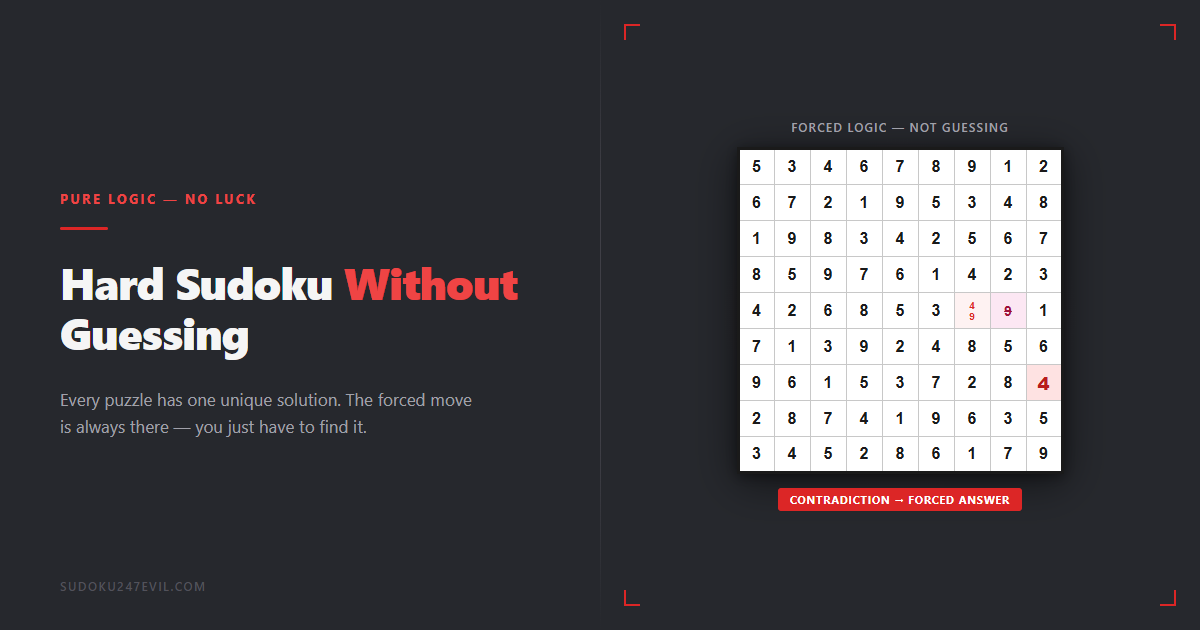
You can train yourself to solve hard sudoku without guessing. The key idea is simple: a proper sudoku puzzle has exactly one unique solution, which means every empty cell has one correct answer that pure logic can reach. When you feel the urge to guess, it’s almost never that the puzzle needs luck — it’s that you’ve missed a deduction that’s already on the board.
This post is about the mindset, not just the moves. The how-to of each technique lives on the Sudoku247 Wiki glossary. Here we’ll work on the habit of slowing down and finding the forced next step instead of rolling the dice.
Why guessing is a signal, not a strategy
Think of guessing as a smoke alarm. It’s not telling you “this puzzle is impossible.” It’s telling you “you’ve stopped looking carefully.”
Because a valid grid has a single solution, every position you reach also has a single way forward built into it. There is always a cell somewhere that can only be one digit, or a candidate somewhere that can only be eliminated. The move exists. Your job is to find it, not to invent one.
When players guess on a hard grid and it happens to work, they don’t actually get better — they just got lucky and reinforced a bad habit. And when a guess goes wrong, you can spend ten minutes unwinding a board you can no longer trust. Logic-only solving is slower at first and far faster once it clicks.
A quick honesty note: we’re teaching no-guessing as a skill you build, not promising that every board is machine-verified guess-free. The goal is to make you the kind of solver who doesn’t need to guess.
Slow down to find the forced move
When you hit a wall, the instinct is to speed up and start trying numbers. Do the opposite. The forced move is usually hiding in plain sight, behind a candidate you forgot to erase.
Run this before you ever consider a guess:
- Refresh your pencil marks. Re-check every candidate against recent placements. Stale marks are the single biggest cause of false dead ends.
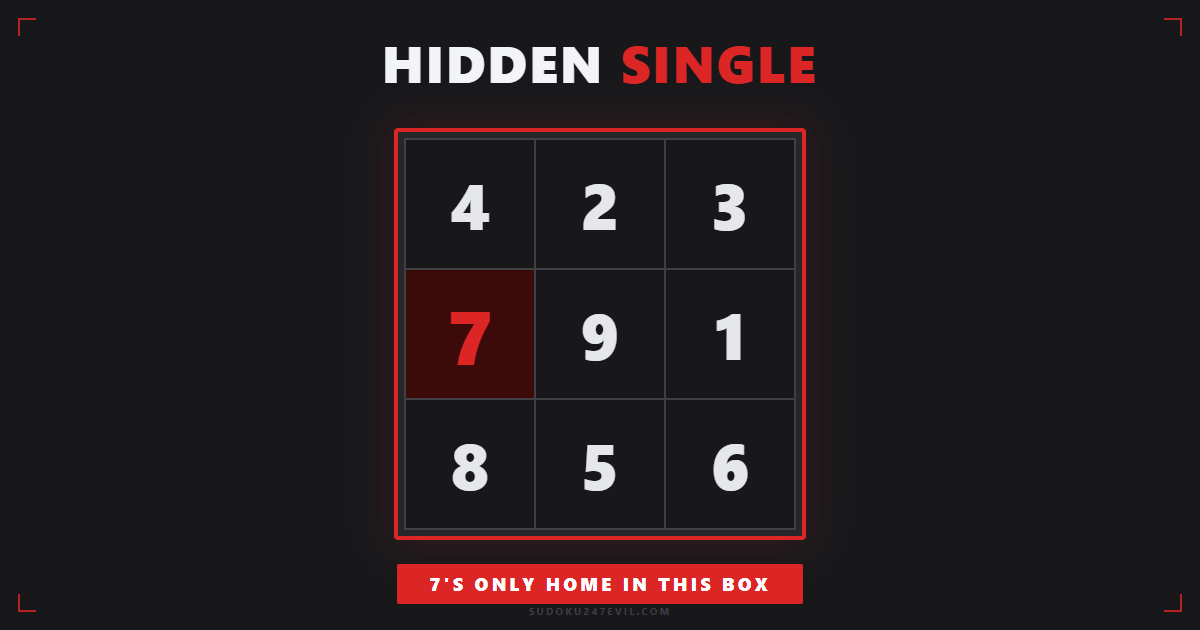
- Re-scan for singles. A naked single (one candidate in a cell) or a hidden single (a digit with only one home in a unit) often reappears after an elimination.
- Look for the eliminations you skipped. A naked pair or pointing pair won’t place a digit, but it clears candidates — and a cleared candidate frequently exposes a single.
Nine times out of ten on a hard puzzle, that loop turns “I have to guess” back into “oh, there it is.”
The technique that replaces guessing
Sometimes the board really is locked and no single, subset, or basic pattern moves it. That’s not the moment to guess — it’s the moment to reason with a chain.
A forcing chain is what people think guessing is, done with logic instead of luck. You pick a cell with two candidates and follow the if-then consequences of each option. If both paths lead to the same conclusion in some other cell, that conclusion is certain — no matter which candidate is true. You’ve proven a move, not gambled on one.
Two gentler relatives are worth keeping in your kit before you go full chain:
- An XY-Wing, where three two-candidate cells pivot to force an elimination.
- Simple coloring, where you tag a single digit’s candidate cells in two colors and let the contradictions do the work.
These feel like guessing because you’re testing consequences — but the conclusion is forced, which is exactly the difference.
A simple example of forced logic
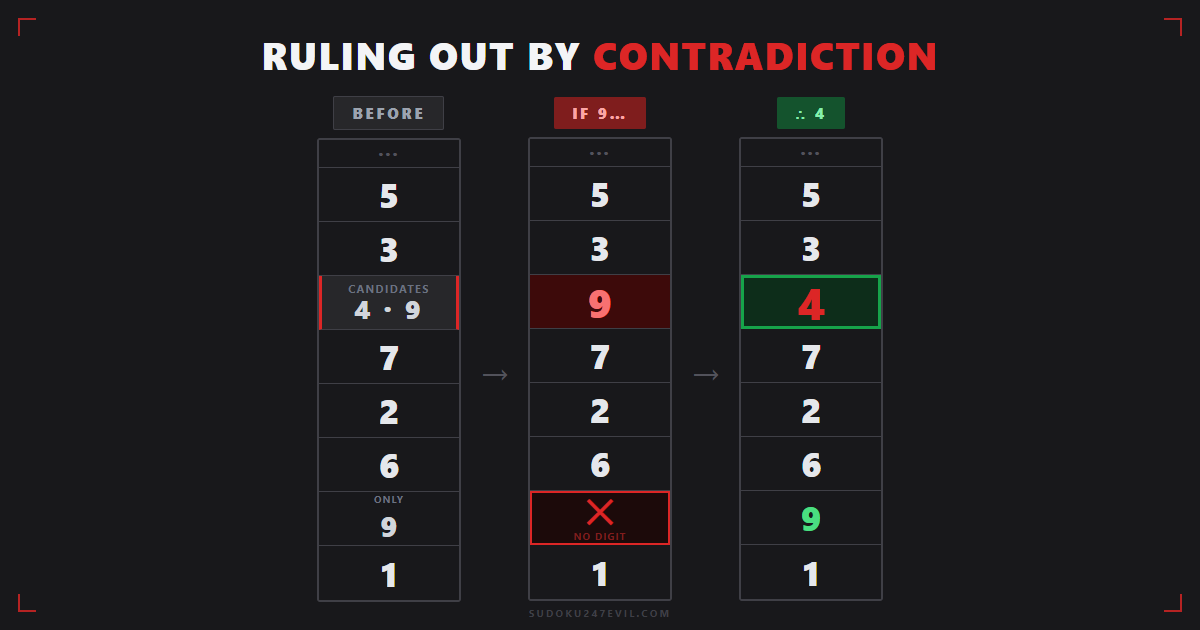
Say a cell can only hold a 4 or a 9, and you notice that placing the 9 there would leave a different cell in the same column with no candidates at all. That’s a contradiction, and a valid puzzle never contains one. So the 9 is impossible, and the cell must be a 4. You didn’t guess — you ruled out the option that breaks the grid. Every “without guessing” solve is built from small certainties like that.
Build the habit on a real grid
The no-guessing mindset only becomes second nature with reps. Sit down with an evil sudoku puzzle and make yourself a promise: no digit goes in until you can say why it’s the only option. When you want a half-step down to drill the basics, an expert sudoku board is a great place to practice the forced-move loop.
Slow is smooth, and smooth is fast. Find the deduction, trust the single solution, and let the grid tell you the answer.
Altro dal blog
- Sudoku Strategies for When You’re Stuck: A ChecklistStuck on a sudoku? Work this checklist: refresh pencil marks, re-scan for singles, switch units, and reach for the techniques you skipped to break the wall.
- Is Sudoku Hard? Easy to Learn, a Lifetime to MasterIs sudoku hard? It’s easy to learn and hard to master. Learn what truly makes a puzzle difficult and how to grow into evil and expert sudoku grids.
- How to Solve Hard Sudoku: A Step-by-Step Order of AttackLearn how to solve hard sudoku step by step with a clear order of attack, the right techniques to reach for, and pencil-mark habits that keep a grid moving.
Pensi di farcela? Dimostralo su una griglia dal vivo.
Gioca a Sudoku Diabolico