Is Sudoku Hard? Easy to Learn, a Lifetime to Master
Veröffentlicht 22.06.2026
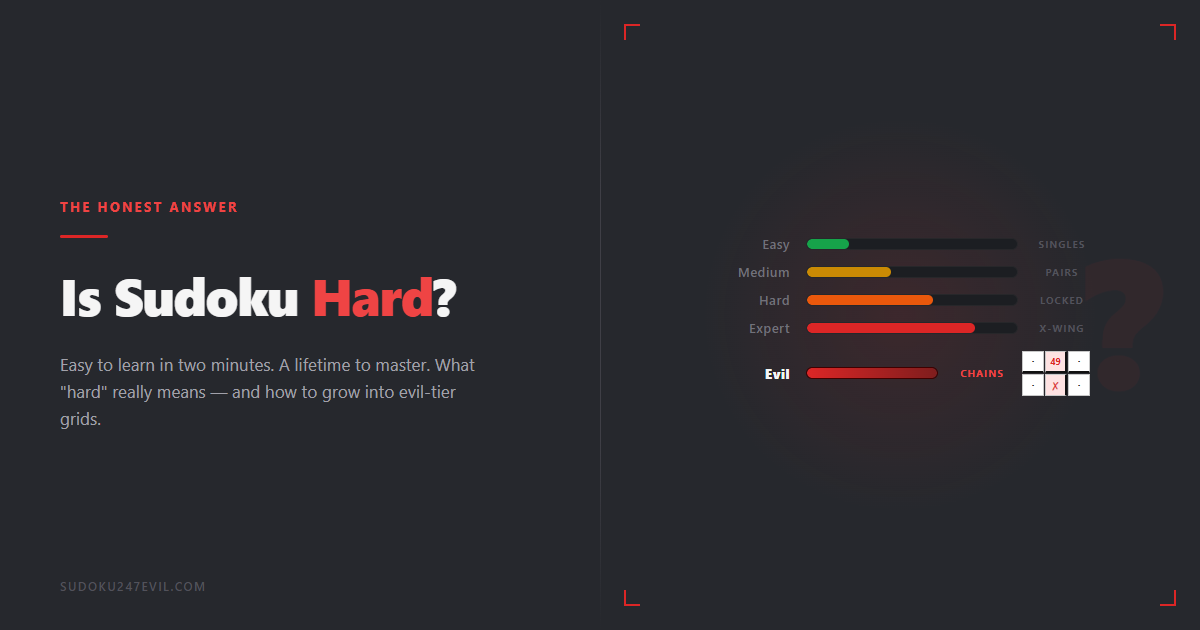
Is sudoku hard? Honestly, no — and also yes. The rules take about two minutes to learn, and the basic puzzles fall to pure logic with a little patience. But mastering the hardest grids is a skill you build over months. Sudoku is the classic “easy to learn, hard to master” puzzle, and that gap is exactly why people stick with it for years.
Let’s clear up what “hard” really means here, why some puzzles feel impossible, and how you grow into the evil tier without burning out.
Is sudoku hard to learn? Not at all
The entire ruleset is one sentence: fill the grid so every row, every column, and every 3×3 box contains the digits 1 through 9, with no repeats. That’s it. If you can count to nine and spot a duplicate, you can play. (The full beginner rundown lives on the Sudoku247 Wiki rules page.)
Easy and medium puzzles are solved almost entirely with two ideas: a cell that has only one possible digit, and a digit that has only one possible cell in a unit. Learn to spot those two patterns and you can finish the majority of puzzles you’ll ever see.
So if you’re brand new and worried sudoku is over your head — it isn’t. The on-ramp is gentle. The challenge comes later, and it’s the good kind.
Is sudoku hard to master? That’s where the depth lives
Mastery is a different animal. Hard, expert, and evil puzzles can’t be cracked with singles alone. They demand techniques that work across the whole grid — locked candidates, pairs and triples, and pattern methods like the X-Wing and Swordfish, or chains like the XY-Wing.
The encouraging part: this is a finite skill tree, not a wall. Each technique you add unlocks a whole band of puzzles that were previously impossible for you. Players who feel stuck at “hard” usually just haven’t learned the next two techniques yet. Once they do, those grids suddenly feel fair.
What actually makes a sudoku “hard”?
Here’s the most common misconception, and it’s worth getting right.
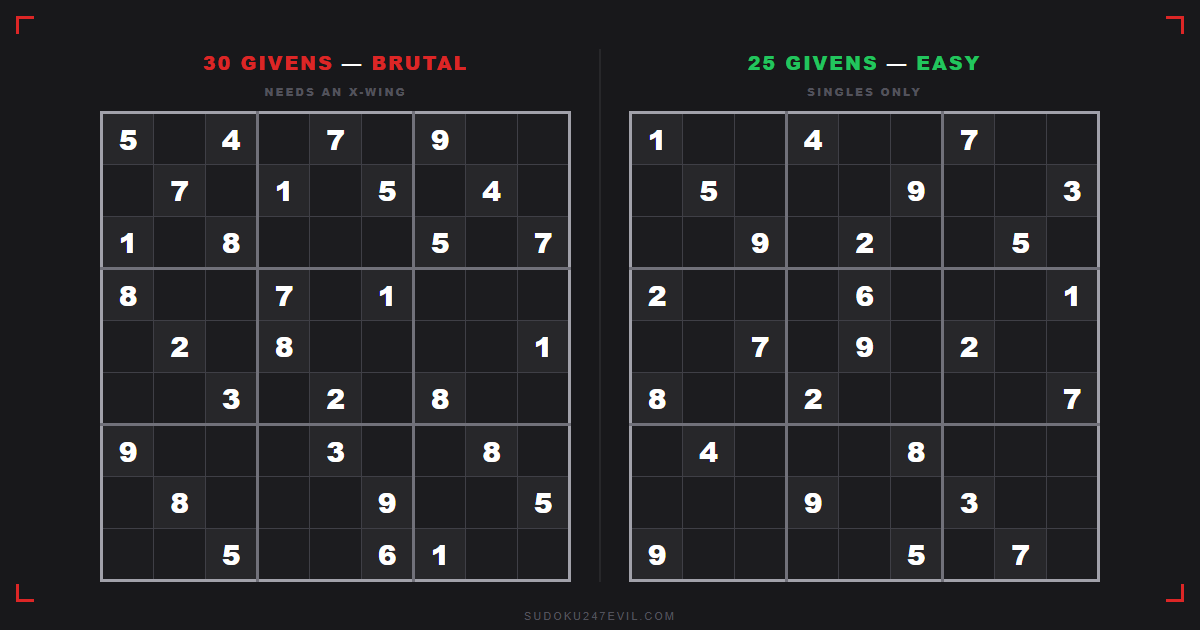
Difficulty is not about how many starting numbers you get. It’s about what those numbers force you to do.
- A puzzle with 30 given digits can be brutally hard.
- A puzzle with 25 givens can be a breeze.
What sets the difficulty is the path to the solution — the hardest technique you’re required to use before the grid opens up. If every step is a forced single, the puzzle is easy even with few clues. If the board stalls until you find a locked candidate, an X-Wing, or a chain, it’s a hard puzzle no matter how generous the starting position looks.
In other words: it’s clue placement, not clue count. A designer can hand you plenty of numbers and still arrange them so the only way forward is an advanced deduction.
A fun fact about clues
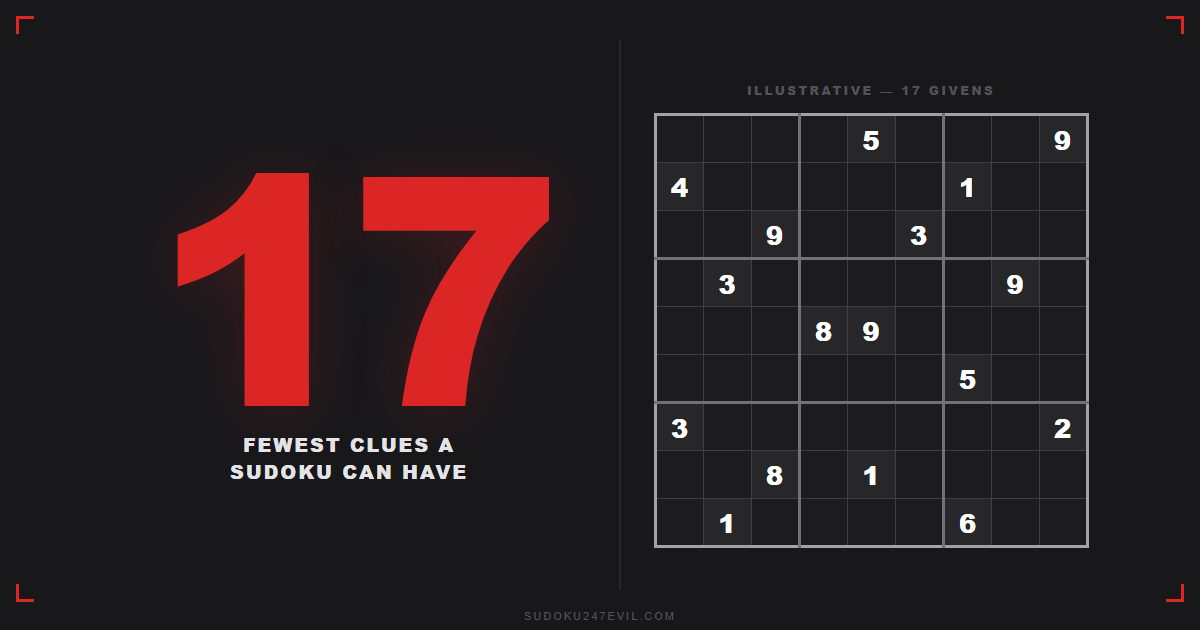
Mathematicians proved in 2012 (a team led by Gary McGuire at University College Dublin) that 17 is the fewest clues a proper sudoku can have while still owning a single unique solution — there is no valid 16-clue puzzle. But don’t read that as “17-clue puzzles are the hardest.” A spacious 17-clue grid can be friendlier than a cramped 28-clue one. Difficulty is about the logic the clues demand, not their headcount.
Why evil and expert puzzles feel impossible
Evil-tier grids feel impossible for one honest reason: they’re built to require techniques most casual players haven’t learned yet. When your toolkit stops at singles and pairs, an expert puzzle hits a wall you genuinely can’t climb — not because you’re not smart enough, but because you’re missing the specific tool the puzzle was designed around.
That’s actually great news. “Impossible” here means “I haven’t learned the next technique,” and that’s completely fixable. Every player who breezes through evil puzzles today once stared at one in disbelief.
How to grow into the hardest puzzles
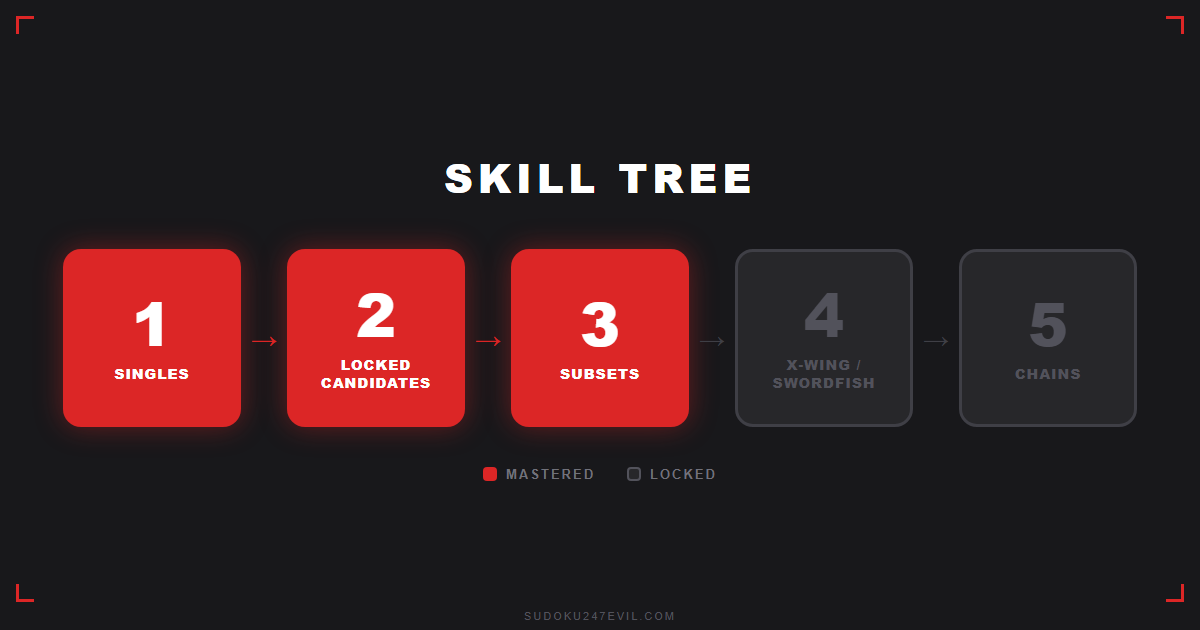
Climb the ladder; don’t leap to the top and get discouraged.
- Solidify singles until you place them on sight.
- Add locked candidates — pointing pairs and box-line reductions appear on nearly every hard grid.
- Layer in subsets — naked and hidden pairs and triples.
- Then learn one pattern technique at a time, starting with the X-Wing.
Each rung makes the next puzzle tier playable. Keep a glossary handy so you can look up a technique the moment a grid demands it.
So — is sudoku hard? It’s as hard as you want it to be, and that’s the whole appeal. When you’re ready to test your ceiling, start on an expert sudoku board and work your way up to a true evil sudoku puzzle. The grid that feels impossible today is just next month’s warm-up.
Mehr aus dem Blog
- Sudoku Strategies for When You’re Stuck: A ChecklistStuck on a sudoku? Work this checklist: refresh pencil marks, re-scan for singles, switch units, and reach for the techniques you skipped to break the wall.
- How to Solve Hard Sudoku Without Guessing (a Skill)Learn to solve hard sudoku without guessing. A proper puzzle has one unique solution, so there’s always a forced logical move waiting to be found.
- How to Solve Hard Sudoku: A Step-by-Step Order of AttackLearn how to solve hard sudoku step by step with a clear order of attack, the right techniques to reach for, and pencil-mark habits that keep a grid moving.
Glaubst du, du packst das? Beweise es an einem Live-Board.
Diabolisches Sudoku spielen