How to Solve Hard Sudoku: A Step-by-Step Order of Attack
Publié 22 juin 2026
Solving hard sudoku is less about being clever and more about being patient and tidy. You work through the board in a fixed order, you keep your pencil marks honest, and you re-check the board every time you place a digit. Do that, and even a brutal grid gives up one cell at a time.
This guide walks you through a realistic order of attack for a hard puzzle, from your first scan to the heavier techniques you save for when nothing else moves. The mechanics of each technique live on the Sudoku247 Wiki glossary — here we focus on when and why you reach for them on a hard grid.
Start where the easy wins are
Even on a hard puzzle, the first job is the same as on an easy one: find the cells that already have only one answer.
- Look for naked singles — a cell with just one candidate left.
- Hunt hidden singles — a digit that can only go in one spot inside a row, column, or box, even if that cell still shows several candidates.
This sounds too basic for a hard grid. It isn’t. The most common mistake players make on tough puzzles is sprinting toward fancy techniques and skipping free placements that are sitting right there. Singles keep appearing all the way to the end, especially after a big elimination opens things up. Always come back to them.
When the obvious singles dry up, that’s your signal to switch from scanning to candidate management. From here, the puzzle becomes a game of marking and eliminating.
Tips for solving hard sudoku: keep your pencil marks clean
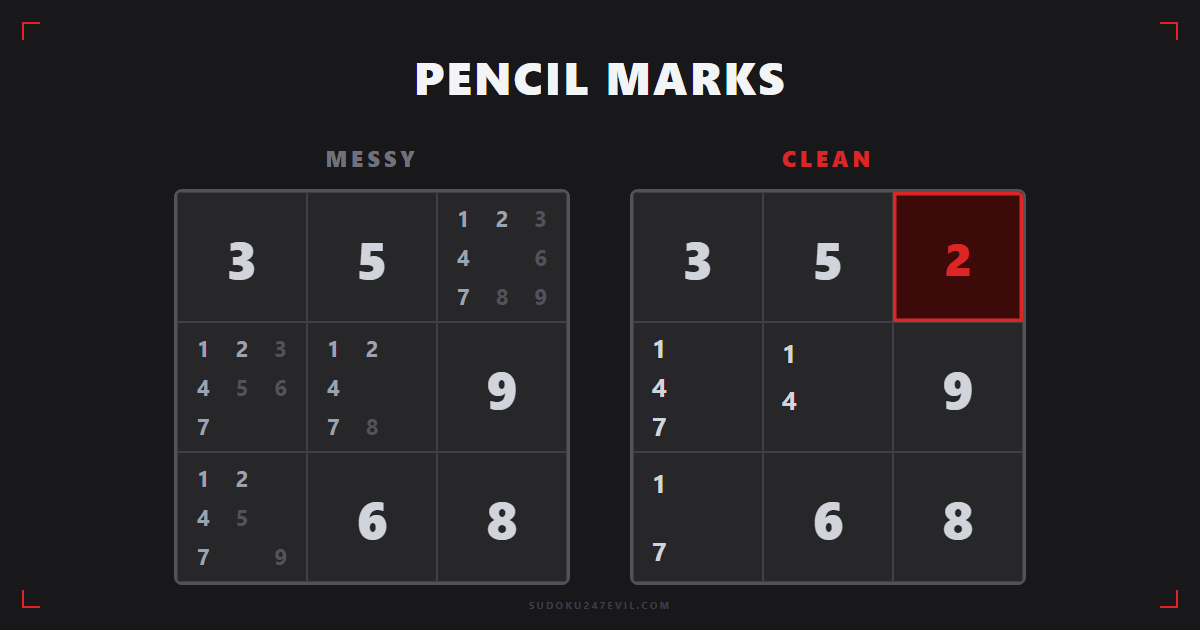
On a hard grid, your pencil marks are the puzzle. If they’re wrong, every deduction you make on top of them is wrong too.
A few habits that pay off:
- Mark fully before you reason. Fill in every candidate for the cells you’re working on. Half-finished marks hide the patterns you’re looking for.
- Erase the moment you place a digit. Put a 5 in a cell, and immediately strike 5 from the rest of that row, column, and box. Stale marks are the number-one reason people get stuck.
- Work the emptiest units first. A box or column that already has six digits placed has fewer candidates to juggle, so it’s where forced moves hide.
If you ever feel lost, it’s usually not that the puzzle got harder — it’s that your marks drifted out of date. Re-scanning your candidates fixes more “impossible” grids than any advanced trick.
How to solve hard sudoku puzzles step by step
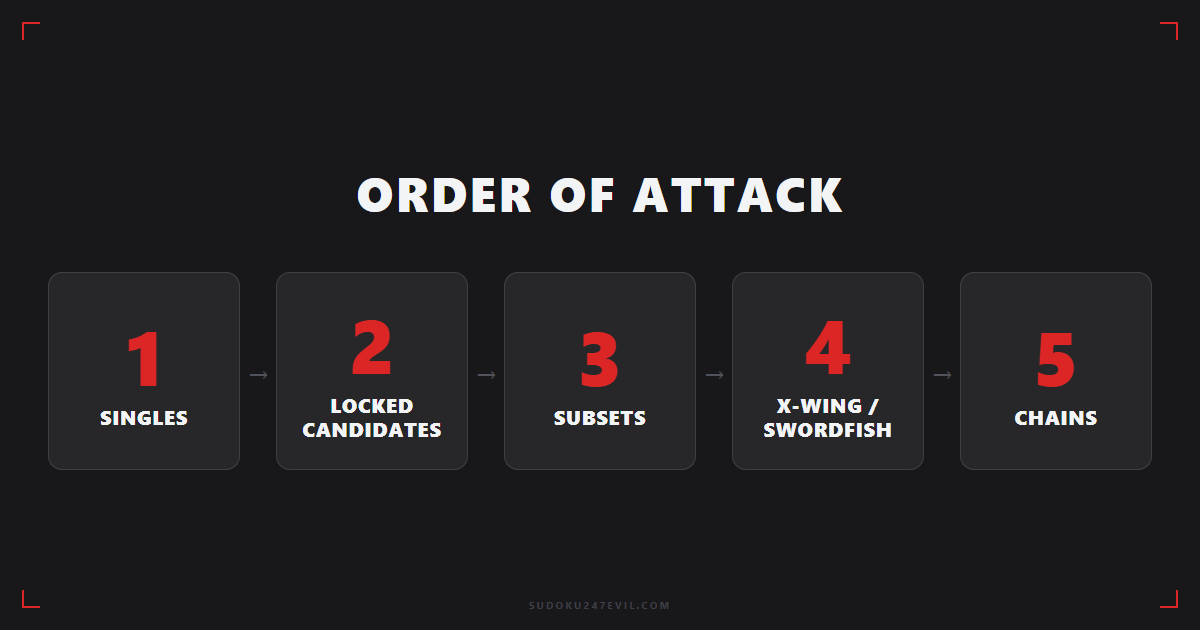
Here’s the loop to run, in order, every time you place something:
- Re-scan for singles. Your last placement may have created a fresh naked or hidden single nearby.
- Look for locked candidates. When a digit inside a box is confined to one row or column, you can strip it from the rest of that line. The wiki calls these pointing pairs and box-line reduction. They’re cheap and they show up constantly on hard puzzles.
- Find subsets. Spot a naked pair, hidden pair, or naked triple. These don’t place a digit by themselves, but they clear out candidates and often unlock a single right after.
- Re-scan again. Every elimination can trigger a single you missed. Loop back to step one before reaching for anything heavier.
Most hard puzzles are solved entirely inside this loop. You only graduate to the next tier when you’ve genuinely exhausted it — not when you’re impatient.
When the loop stalls: the bigger techniques
If you’ve cleaned your marks, run the loop, and the board still won’t budge, it’s time for pattern techniques that span the whole grid:
- An X-Wing when a digit lines up in exactly two spots across two rows (or two columns).
- A Swordfish — the same idea stretched across three lines, for the nastier grids.
- An XY-Wing or Y-Wing when you have a chain of three cells that pivot on a shared candidate.
These take effort for a small payoff, so they’re a last resort, not a first move. But on a truly hard grid, sometimes a single X-Wing is the one elimination that reopens the whole puzzle.
A simple worked moment
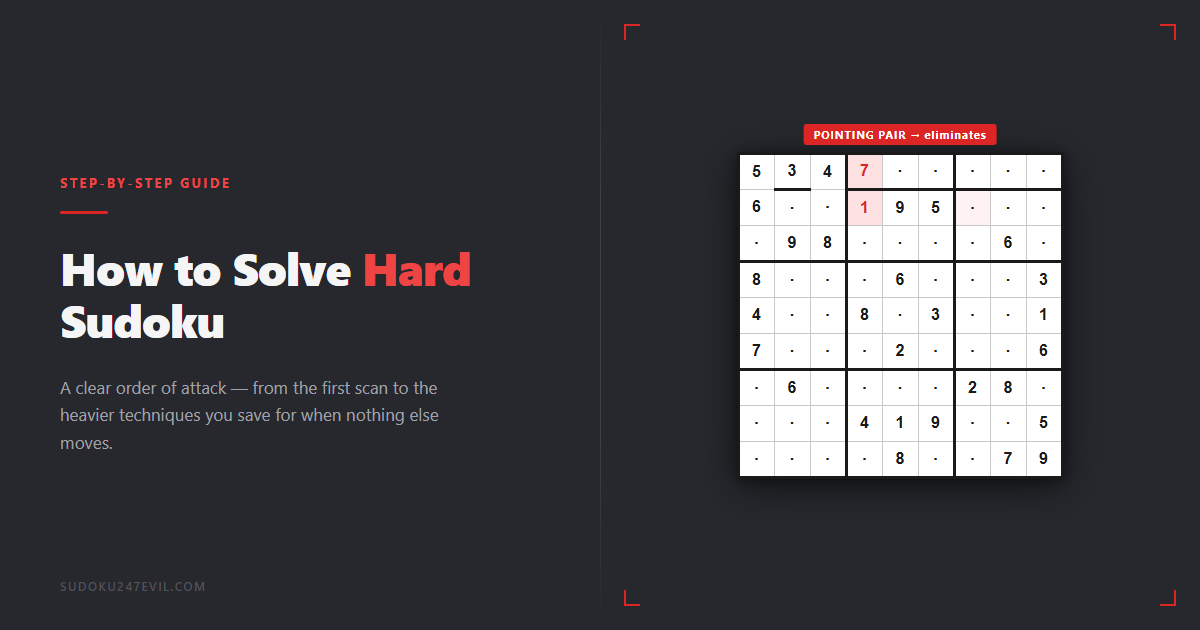
Picture a hard grid where, in the top band, the digit 7 can only sit in row 1 within a single box. That means 7 is “pointing” along row 1 — it has to be somewhere in that box’s slice of the row. So you can safely erase 7 as a candidate from the rest of row 1 in the other two boxes. You haven’t placed a digit, but you’ve likely just created a fresh single somewhere down the line. That’s the rhythm of hard sudoku: small, certain eliminations that snowball.
Ready to put it into practice?
Reading about it only gets you so far — the order of attack sticks once your hands do it. Warm up on a hard sudoku board, then test everything you just learned against a real evil sudoku puzzle when you want the grid to bite back.
Take your time, keep your marks clean, and trust the loop. The hardest puzzle on the board still surrenders one forced cell at a time.
Plus du blog
- Sudoku Strategies for When You’re Stuck: A ChecklistStuck on a sudoku? Work this checklist: refresh pencil marks, re-scan for singles, switch units, and reach for the techniques you skipped to break the wall.
- How to Solve Hard Sudoku Without Guessing (a Skill)Learn to solve hard sudoku without guessing. A proper puzzle has one unique solution, so there’s always a forced logical move waiting to be found.
- Is Sudoku Hard? Easy to Learn, a Lifetime to MasterIs sudoku hard? It’s easy to learn and hard to master. Learn what truly makes a puzzle difficult and how to grow into evil and expert sudoku grids.
Tu penses pouvoir l'affronter ? Prouve-le sur une grille en direct.
Jouer au sudoku diabolique